


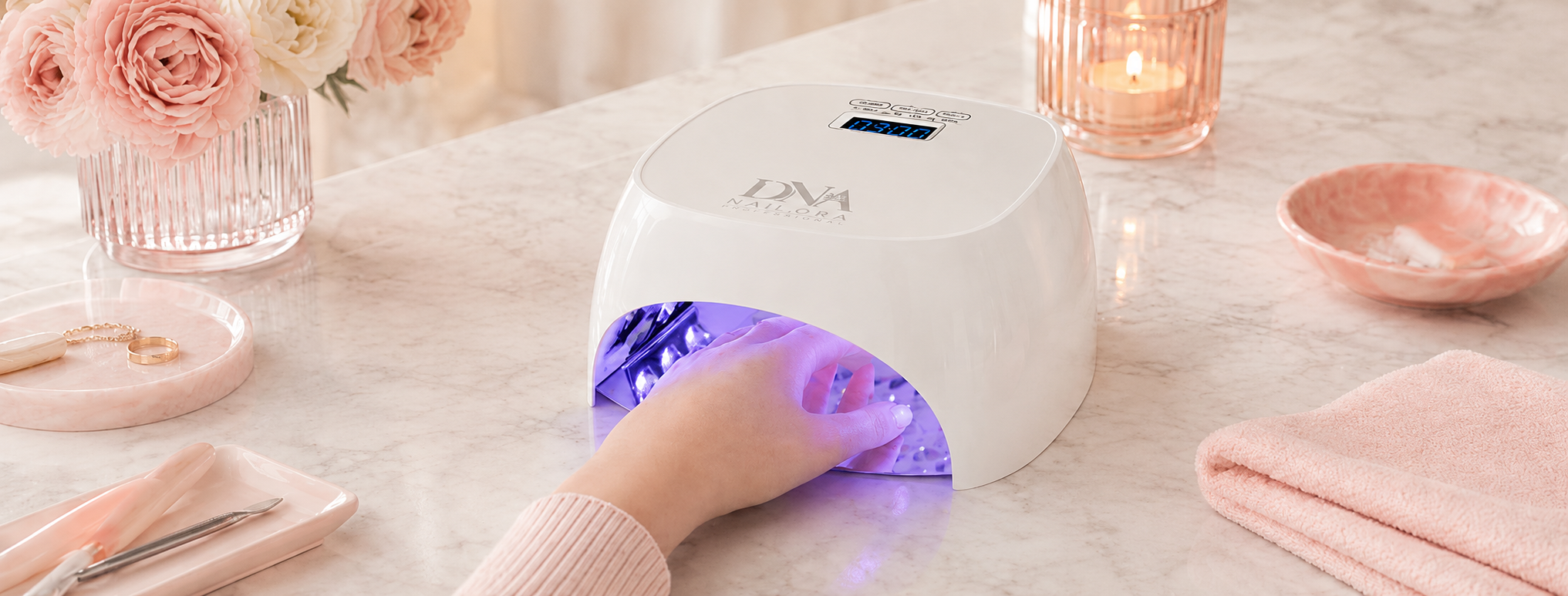
UV/LED curing and TPO-free gels: why choosing the right lamp has become essential
Since the new European regulations and the reformulation of TPO-free gels, curing has become an even more important topic in professional nail services. In the past, some formulas were more forgiving with the UV/LED lamps used. Today, with the replacement of certain photoinitiators, not all gels react the same way under every lamp. A lamp that is too weak, aging, or whose wavelength is not suitable can cause incomplete curing, even if the gel feels hard on the surface. At DesignNailArt, we place great importance on this step, because proper curing directly affects wear, strength, shine, safety of use, and client comfort.
Why has this become even more important?
TPO, also called Trimethylbenzoyl Diphenylphosphine Oxide in the INCI list, was a photoinitiator used in some UV gels and gel polishes. Its role was to help the product harden under a UV/LED lamp.
Since September 1, 2025, TPO has been banned in cosmetic products in the European Union. This ban forced manufacturers to reformulate many products with other photoinitiator systems.
These new formulas can be very high-performing, but they require more precise curing. The lamp must emit the right light, with sufficient intensity and good distribution inside the unit.
| Before reformulations | Some gels were easier to cure with a wide variety of lamps. |
| Since TPO-free formulas | Compatibility between the lamp, wavelength, and gel has become more sensitive. |
| Impact for professionals | It is important to use a reliable lamp, suited to modern gels and regularly checked. |
How does curing work?
A UV/LED gel contains monomers, oligomers, and photoinitiators. Before curing, the material is liquid, semi-liquid, or paste-like. When exposed to the lamp’s light, the photoinitiators absorb this energy and trigger a polymerization reaction.
This reaction gradually transforms the material into a solid, durable network. This process is what allows the gel to harden, adhere properly, and reach its final strength.
Successful curing therefore does not depend only on the time spent under the lamp. It also depends on the gel formulation, the lamp’s actual output, the emitted wavelength, the condition of the LEDs, the applied thickness, and the position of the hand in the lamp.
Wavelength: a point not to overlook
A UV/LED lamp emits light in a specific area of the spectrum, expressed in nanometers — for example 365 nm, 385 nm, 395 nm, or 405 nm.
The photoinitiators in gels do not all react to the same wavelength. If the lamp does not emit in the right range, or if its intensity is too low, curing may be insufficient.
Due to changes made to photoinitiators in TPO-free formulas, effective emission around the 385–395 nm range has become essential for certain formulas.
| Suitable wavelength | The gel receives the energy needed to cure properly. |
| Unsuitable wavelength | The gel may feel hard on the surface but remain insufficiently polymerized deeper down. |
| Aging lamp | LEDs can lose efficiency over time, reducing curing quality. |
Wattage alone isn’t enough
Many people still choose their lamp only by looking at the number of watts. This is a common mistake.
The stated wattage alone does not guarantee good curing. A poorly designed or aging 54W lamp can be less effective than a well-designed lamp with more even light output.
What really matters:
- the wavelength emitted by the LEDs
- the light intensity actually received by the nail
- LED distribution inside the unit
- the presence of a reflective base or suitable bottom plate
- the distance between the nails and the LEDs
- the overall condition of the lamp
- following the recommended curing time
The risks of poor curing
Poor curing is not always immediately visible. The gel may appear hard on the surface, while the material is not fully polymerized deeper down.
| Premature lifting | The product has not reached its optimal strength. |
| Loss of shine | The finish may become dull more quickly. |
| Soft material | The gel may remain flexible, rubbery, or fragile. |
| Uneven wear | Some fingers may last less well depending on their position in the lamp. |
| Unpolymerized residue | Incomplete curing can leave more uncured material. |
This is why it’s important not to shorten curing times, even when the product feels hard after a few seconds.
Product thickness matters too
The thicker a gel layer is, the more the light must penetrate the material. A thin layer of gel polish cures more easily than an apex, a build, or a thicker reinforcement.
Dark, highly pigmented colors, whites, blacks, or glitter gels may also require special attention. Pigments can limit light penetration, making it even more important to follow curing times.
For technical products, it is recommended to work at a reasonable thickness and follow the recommendations indicated on the product sheet.
Why are some lamps no longer enough?
With older formulas, some entry-level lamps could deliver an acceptable result. With new TPO-free formulations, this is not always the case anymore.
A lamp can be an issue if:
- it is too old or has lost intensity
- it doesn’t have enough well-distributed LEDs
- it doesn’t properly cover thumbs
- it doesn’t have a reflective base
- it isn’t suited to the photoinitiators in modern gels
Mini portable lamps can be handy for nail art or a repair, but they don’t always replace a true professional lamp for curing a full set.
Sensitive mode and heat
Curing can generate a sensation of heat. This reaction is normal: when the gel polymerizes, it releases energy. The thicker the layer, the more the reaction can be felt.
Some lamps have a sensitive mode (low heat mode) that gradually increases power. This mode is particularly useful for:
- builder gels and reinforcements
- sensitive clients
- thin or weakened nails
- sets where the material is applied thicker
Warning: sensitive mode should not be used to reduce the total curing time. It is meant to improve comfort, not to speed up hardening.
How to use your UV/LED lamp properly?
- Place the hand flat inside the lamp
- Avoid fingers touching the sides
- Pay attention to the thumb, often poorly positioned
- Follow the time indicated on the product
- Do not cure layers that are too thick if the product isn’t designed for it
- Regularly clean the base and the inside of the lamp
- Replace a lamp that is too old or unstable
- Use a professional lamp for full sets
How to choose a good lamp?
For professional use, it’s best to choose a lamp designed for even, consistent curing.
| Criterion | Why it matters |
|---|---|
| Sufficient power | It helps ensure effective curing, especially for technical gels. |
| Well-distributed LEDs | They prevent less-exposed areas, especially on the sides and thumbs. |
| Suitable wavelengths | They properly activate the photoinitiators in modern gels. |
| Sensitive mode | It improves comfort while curing thicker products. |
| Reflective base | It helps distribute light better around the nails. |
| Cabin format | It allows the hand to be positioned correctly without touching the sides. |
A good lamp is an investment, but it directly contributes to work quality, set longevity, and client satisfaction.

- TPO has been banned in cosmetics in Europe since September 1, 2025.
- Gels have been reformulated with other photoinitiators.
- New formulas may require a more precise, more reliable lamp.
- Wattage alone is not enough to judge a lamp’s quality.
- Wavelength, intensity, LED distribution, and curing time are essential.
- Poor curing can reduce wear, strength, and shine.
- A suitable professional lamp is essential for reliable results.
Our DesignNailArt advice
Since the TPO-free reformulations, we advise professionals not to underestimate the role of the lamp. A good gel cannot deliver its full results if curing is not correct.
To work under good conditions, choose a professional UV/LED lamp that is powerful enough, with good LED distribution, a sensitive mode, and emission suited to today’s gels.
If you notice unusual lifting, a material that feels soft, a finish that loses its shine, or uneven wear, the lamp is one of the first things to check.
Sources used
European Commission, Questions & Answers about TPO in nail products, accessed in 2026: official source
Belgian FPS Public Health, Ban on TPO in cosmetic products from 1/9/2025, published on 25/08/2025 and updated on 17/11/2025: official source
HPRA Ireland, TPO added to European Union list of prohibited ingredients, 29/07/2025: regulatory source
PCI Magazine, UV/LED Photoinitiator and Cure Study, 01/05/2014: technical source